
A potential customer asks Google: “Which digital marketing agency near me has the best reviews?” They never type a URL. They never scroll past the first three results. Within seconds, they are calling a business whose Google Maps listing gave them enough confidence to act. If that business is not yours, the opportunity is gone.
The numbers make this impossible to ignore. 46% of all Google searches have local intent. 76% of mobile users who search for something nearby visit a business within a day. Google Maps has become the primary decision-making surface for local search , and with AI-powered features, voice queries, and conversational search now shaping results, the stakes are higher than ever.
Most brands are still optimizing for 2021. They set up their Google Business Profile once, collected a few reviews, and moved on. Google Maps SEO in recent days is the discipline of building local authority signals that turn search visibility into consistent, qualified customer contact.
What Is Google Maps SEO and Why Does It Matter?
Google Maps SEO is a coordinated discipline, not a single tactic. It combines your Google Business Profile optimization, NAP (name, address, phone number) consistency, review management, website local signals, and external citation authority into a unified local presence that Google trusts enough to recommend.
What makes it distinct from traditional SEO is physical context. Google Maps results are tied to your location, proximity to the searcher, and how accurately your online presence reflects your real-world identity.
Three developments have made this more critical than ever: voice search now requires structured, accurate profile data to surface your business; AI Overviews synthesize your reviews, GBP data, and website authority to generate direct recommendations; and “near me” searches now rely on profile completeness and real user engagement, not keyword placement, to determine your ranking.
Google Maps Ranking Factors: How Google Decides Who Appears
Understanding how Google decides local rankings is the foundation of any effective Google Maps optimization strategy. Here are the three core pillars-
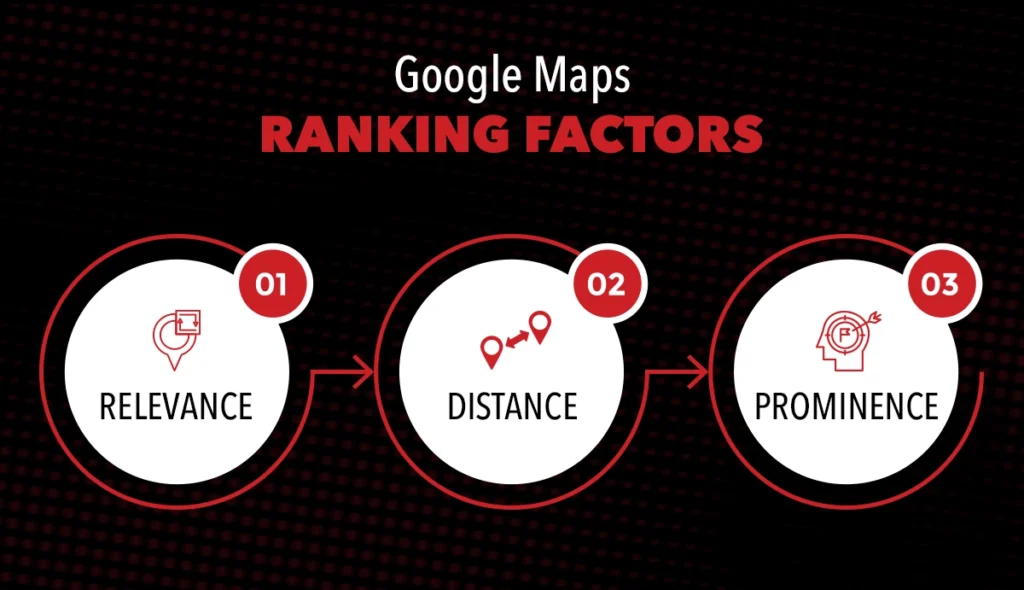
- Relevance: How closely your business matches the intent behind a search query. Your primary GBP category, services listed, business description, and website content all contribute. A physiotherapy clinic with the correct primary category and detailed treatment pages has stronger relevance for “sports injury physiotherapist near me” than a generic health clinic with a sparse profile.
- Distance: How far your business is from the searcher’s location or the place named in the query. You cannot optimize away physical distance, but you can clearly define your service area through location-specific content.
- Prominence: How well-known and trusted your business appears across the web. Reviews, backlinks, directory citations, editorial mentions, and your overall organic search authority all feed into prominence. This is the pillar most directly influenced by sustained Google Maps local SEO effort.
Google Business Profile Optimization: Your Most Powerful Local Ranking Asset
Your Google Business Profile controls everything a customer sees when they find you in Maps, including category, hours, reviews, photos, and more. Most businesses set it up once and forget it. That single habit is costing them rankings.
1. GBP Optimization Checklist
- Verify profile ownership through Google’s official verification process
- Use your exact real-world trading name, no keyword additions
- Select the single most accurate primary category available
- Add all relevant secondary categories for services you genuinely provide
- Complete every service entry with accurate descriptions and pricing where applicable
- Write a business description that explains what you offer, who you serve, and where you operate
- Keep regular hours current and update special hours for public holidays
- Upload high-quality, recent photos of your premises, team, and work
- Add your correct phone number and link to the most relevant website page
- Enable messaging and booking features where available for your category
- Respond to every review within 24 hours, positive and negative
- Use the Q&A section to answer genuine customer questions accurately
- Publish GBP posts regularly for updates, offers, or useful local information
2. Google Business Profile Activity Signals
Beyond completeness, Google Business Profile activity signals how frequently you update your profile, add photos, publish posts, and respond to reviews, indicating to Google that your listing is maintained and reliable. An inactive profile, even a complete one, signals lower confidence to Google’s local ranking system. Treat your GBP the way you would treat your most visited webpage: review it monthly, update it seasonally, and never let it go stale.
Once your profile is optimized, the next question is: what business impact does stronger Maps visibility actually create?
3. GBP setup for service-area businesses
Plumbers, consultants, agencies, and home service providers follow different GBP rules , and getting them wrong risks suspension or suppressed rankings.
- Hide your address if customers never visit your location
- Define your service area by cities or pin codes you genuinely serve, not where you are based
- Never use a virtual office address , Google detects and penalizes it
- Your category and description carry more ranking weight without a fixed address, so be precise
- Reviews mentioning specific locations you serve strengthen geographic relevance for those areas
- Back your service area with dedicated location pages on your website
Service-area businesses can rank in the local 3-pack , but only when the profile is configured correctly.
The Impact of Google Maps Visibility on Brand Growth
Strong Google Maps visibility does not just improve your search position , it directly influences how many customers contact, visit, and choose your business. Understanding the full commercial value of Google Maps local SEO helps you justify the investment internally and build a strategy that leadership will support. These are the outcomes that matter.
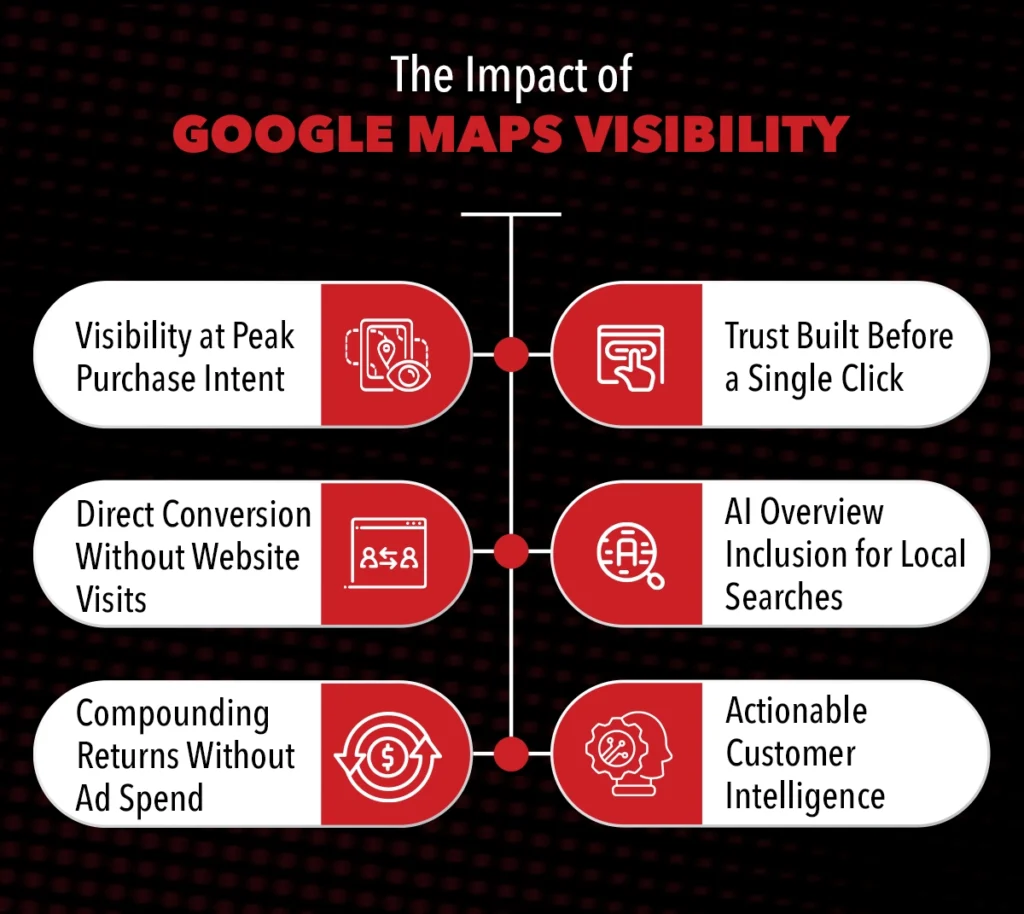
1. Visibility at Peak Purchase Intent
Appearing in the local 3-pack means your business name, rating, and contact details are visible above organic results for queries with local intent. The customer searching “best HR consulting firm in Gurgaon” is ready to act; your Maps listing is the first thing they evaluate.
2. Trust Built Before a Single Click
Your star rating and review count are visible before a customer clicks anything. A listing showing 4.7 stars and 290 reviews immediately outcompetes a rival at 3.8 stars with 11 reviews, before a single word of your website copy is read.
3. Direct Conversion Without Website Visits
Tap-to-call, tap-for-directions, and tap-to-book actions let customers convert directly from your Maps listing. Direction requests in particular signal high intent; someone asking for directions is minutes away from arriving at your business.
4. AI Overview Inclusion for Local Searches
Google AI Overviews for local businesses synthesize data from your GBP, review sentiment, and website authority to generate direct recommendations in search results. Brands with strong Google Business Profile SEO and high-quality reviews are more likely to be cited in these AI-generated answers, an emerging visibility channel that most brands have not yet optimized for.
5. Compounding Returns Without Ad Spend
Unlike paid search campaigns, Google Maps SEO builds authority that compounds over time. Stronger reviews, consistent citations, and a well-maintained profile produce growing returns across months and years ,without restarting when a budget is paused.
6. Actionable Customer Intelligence
Your GBP Insights dashboard shows which queries trigger your listing, how customers find you, and which actions they take. This intelligence reveals gaps between what your customers search for and what your profile communicates, gaps that, once closed, directly improve your Google Maps visibility outcomes.
Strategies to Improve Google Maps Ranking and Local Visibility
Knowing the ranking factors is not enough- execution is where most brands fall short. These strategies target the specific actions that move a business from Maps obscurity into the local 3-pack and keep it there.
1. Fix Your Primary Category First
Your primary GBP category is your strongest relevance signal. Choose the one that most precisely describes your core business, not the broadest option available.
2. Build a Review Generation System
Review velocity carries more ranking weight than a one-time surge. Send review requests within 24 to 48 hours of a completed service and respond to every review within 24 hours.
3. Resolve NAP Inconsistencies Everywhere
Audit every directory listing your business and correct every mismatch in name, address, and phone number. Even minor formatting differences create ambiguity for Google’s local ranking system.
4. Create Distinct Location Pages on Your Website
Each area you serve needs a dedicated page with local NAP details, service specifics, customer testimonials, and schema markup. A copy-pasted template with the city name swapped does not count.
5. Optimise for Voice and Conversational Queries
Add FAQ content that mirrors how people actually ask questions: “Are you open on Sundays?” “What areas do you serve?” These answers belong in your GBP description, Q&A section, and website.
6. Build Authority Through Local Mentions
One mention in a respected regional publication delivers more ranking signal than fifty low-authority directory submissions. Pursue coverage from local business publications, trade bodies, and chamber of commerce listings.
7. Use GBP Posts to Signal Activity
Publish posts regularly for service updates, offers, or useful local information. Posts that offer real value signal profile activity far more effectively than content engineered for keyword insertion.
8. Track, Analyse, and Adjust Monthly
Review your GBP Insights data every month and run a competitor gap analysis every quarter. The gaps you find become your next optimisation cycle.
Google Maps SEO vs. Traditional SEO
These two disciplines overlap significantly but serve different objectives. Understanding the distinction helps you allocate budget and effort correctly, and explains why strong organic rankings do not automatically translate into Google Maps SERP features visibility.
| Dimension | Google Maps SEO | Traditional Organic SEO |
| Primary platform | Google Maps and local pack | Google organic search results |
| Core ranking signals | Relevance, distance, prominence | Content quality, authority, backlinks |
| Geographic dependency | High proximity is a direct factor | Low rankings not location-bound |
| Primary asset | Google Business Profile | Website pages and content |
| Review impact | Direct and significant | Indirect- via trust and CTR |
| Timeline to results | Weeks to a few months | Several months to over a year |
| AI Overview impact | High- GBP data feeds AI answers | Moderate- content quality primary |
Google Maps SEO Statistics
Google Maps is now the primary discovery engine for local businesses , and the data backs it up.
1. Local Search Growth
46% of all Google searches are looking for local information. 72% of consumers who did a local search visited a store within five miles.
2. Mobile Local Search Behavior
Most of mobile searchers are more likely to contact a local business if they have a mobile-friendly site. And most of people prefer using mobile phones to look up info about brands and products online.
3. Review Impact
90% of customers read at least two reviews before choosing a business, and nearly 80% of all online reviews live on Google.
4. Local Pack CTR
92% of searchers pick businesses on the first page of local search results. Search result information sends 70% of consumers to a physical store.
Why Google Maps Rankings Drop: Common Mistakes to Avoid
Rankings rarely collapse without a cause. Most drops trace back to one of these avoidable mistakes, and each one has a clear resolution.
Understanding why rankings fall is as important as knowing how to build them. Addressing these proactively protects the authority you have invested in building.
Mistake: 1
Keywords stuffed into your business name. Fix: Revert to your exact real-world trading name immediately. Keyword additions violate Google’s guidelines and risk profile suspension.
Mistake: 2
Inconsistent NAP data across directories. Fix: Run a full citation audit. Correct mismatches on high-authority platforms first, then update your GBP last.
Mistake: 3
Ignoring negative reviews. Fix: Respond professionally within 24 hours. Acknowledge the issue specifically, offer a resolution pathway, and move sensitive discussions offline.
Mistake: 4
An inactive or incomplete GBP. Fix: Treat profile maintenance as a monthly task, update hours, add photos, publish posts, and answer new questions as they appear.
Mistake: 5
Thin or duplicated location pages. Fix: Each location page must contain genuinely distinct, useful content. Remove or consolidate pages that repeat the same text with only the city name changed.
Mistake: 6
Fake reviews or virtual office addresses. Fix: Remove manipulated reviews and report guideline violations through Google’s Business Redressal Complaint Form. Profiles built on manipulation are fragile by design.
KPIs to Measure Google Maps SEO Success
Measuring the right metrics tells you whether your Google Maps optimization effort is producing real business outcomes, not just profile impressions. These KPIs should be reviewed monthly and benchmarked against the previous period and against your top three local competitors.
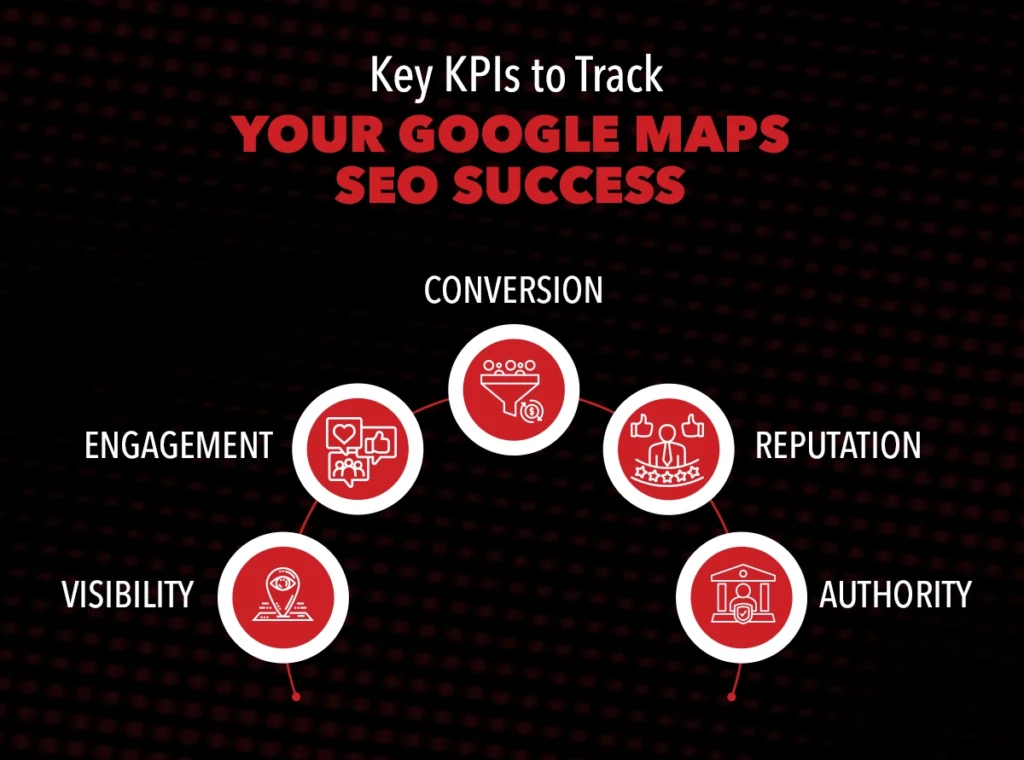
Visibility
- Local pack ranking for primary keywords across your service area
- Total GBP impressions (Maps vs. Search breakdown)
- Profile discovery rate- branded vs. unbranded search queries
Engagement
- Photo views per month
- GBP post clicks and Q&A interactions
- Profile completeness score
Conversion
- Calls placed directly from Maps (via GBP Insights)
- Direction requests per month
- Website clicks and booking actions from your GBP
Reputation
- Overall Google star rating and monthly change
- New review count and velocity
- Review response rate and average response time
Authority
- NAP consistency score across audited directories
- Number of accurate citations on credible platforms
- Local backlinks from regional or industry sources
Google Maps SEO for Multi-Location Businesses
Managing Google Maps SEO across multiple locations isn’t just about duplicating your single-location strategy , it requires a fundamentally different approach. Each location needs its own fully optimized Google Business Profile, consistent NAP (name, address, phone) data across every directory, and a steady stream of location-specific reviews.
Without this structure, individual branches cannibalize each other in local rankings or simply disappear from the local pack entirely. For multi-location brands, local visibility isn’t a marketing nice-to-have , it’s a direct driver of foot traffic and revenue at scale.
How Local Backlinks Improve Google Maps Rankings
Local backlinks signal to Google that your business is a trusted, established part of the community , directly strengthening your Maps visibility.
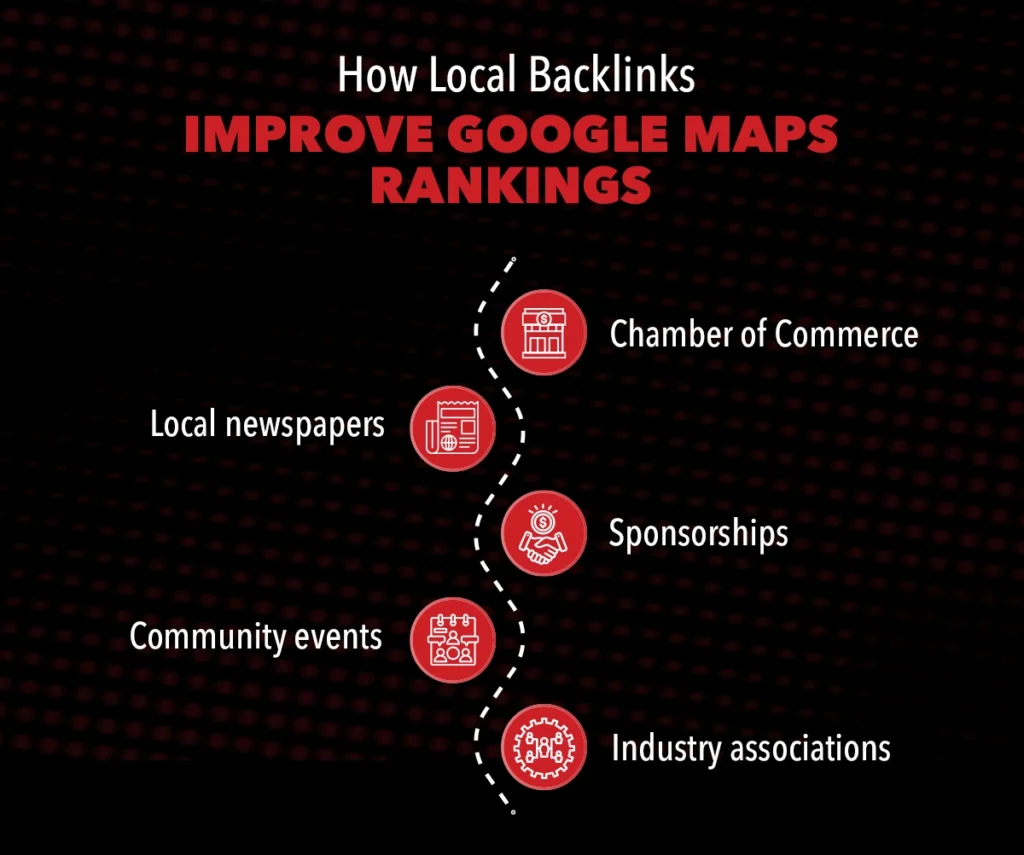
1. Chamber of Commerce
Getting listed on your local Chamber of Commerce website is one of the highest-authority local citations you can earn. These links carry significant trust signals because Google recognizes chamber directories as credible, location-specific sources.
2. Local Newspapers
A mention or feature in a local news outlet generates a backlink that ties your business to a specific geographic area. Even a single story about your business, a new opening, or a community initiative can meaningfully boost local relevance signals.
3. Sponsorships
Sponsoring local events, sports teams, or community programs often earns a backlink from the organizer’s website. These links are natural, editorially placed, and directly associate your brand with a specific location in Google’s eyes.
4. Community Events
Hosting or participating in community events creates opportunities for backlinks from event pages, local blogs, and neighborhood websites. Google treats these as strong proximity signals, reinforcing that your business is active and embedded in the local area.
5. Industry Associations
Being listed on a regional or local industry association directory builds both authority and geographic relevance simultaneously. These backlinks tell Google your business is a legitimate, recognized player within a specific field and location.
Common Google Maps SEO Mistakes We See Across Businesses
Avoiding these mistakes is just as important as following best practices , each one can quietly suppress your local rankings without you realizing it.
1. Keyword Stuffing in Your Google Business Profile Name
Adding keywords to your business name field , beyond your actual registered name , violates Google’s guidelines and can get your listing suspended. Google’s algorithm is sophisticated enough to rank you for relevant terms without forcing them into your profile name.
2. Inconsistent NAP Information Across Business Directories
When your name, address, and phone number appear differently across Yelp, Facebook, and dozens of other directories, Google loses confidence in your business data. That inconsistency directly suppresses your local pack rankings, since trust in your location data is a core ranking signal.
3. Ignoring Negative Reviews and Customer Feedback
Leaving negative reviews unanswered signals to both Google and potential customers that your business is unresponsive. Thoughtful, professional replies to criticism demonstrate engagement , a behavioral signal Google actively factors into local rankings.
4. Maintaining an Inactive or Incomplete Google Business Profile
An incomplete profile with missing hours, no photos, or outdated information tells Google your listing isn’t worth surfacing prominently. Profiles with regular updates, fresh images, and complete service details consistently outperform neglected ones in local pack results.
5. Using Thin or Duplicate Location Pages
Creating near-identical pages for each location , with only the city name swapped out , provides no real value to users and gets flagged as duplicate content. Each location page needs unique, locally relevant content to rank independently in its target area.
6. Using Fake Reviews or Virtual Office Addresses
Purchasing reviews or listing a virtual office to appear in a city where you have no real presence are both violations Google actively detects and penalizes. Beyond the ranking risk, fake signals erode the genuine trust that drives real customers through your door.
The BrandLoom Framework for Google Maps SEO
BrandLoom’s approach treats Google Maps optimization as a local authority program, not a checklist. The framework moves through five phases, each building on the last to produce compounding visibility rather than a temporary ranking spike.
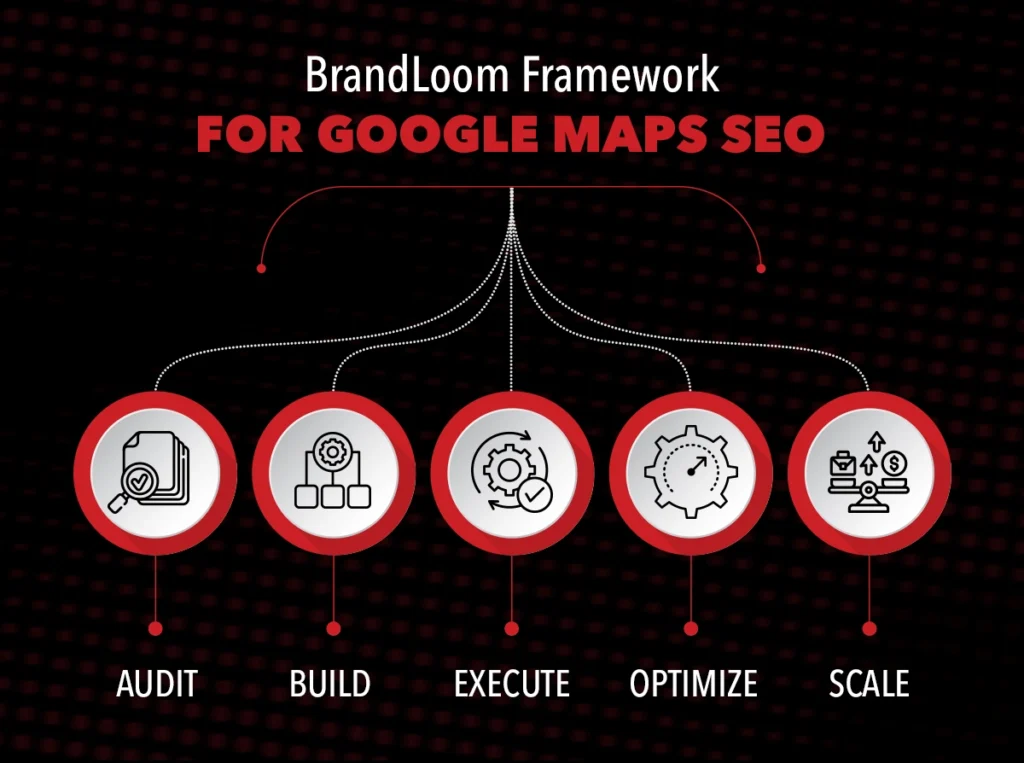
Audit
Complete diagnostic of your GBP accuracy, NAP consistency, review profile, website local signals, competitor benchmarks, and current Maps ranking across your service area. Gaps are identified and prioritized by potential ranking impact.
Build
Correct categories, complete all profile fields, resolve NAP inconsistencies, remove duplicate listings, create location-specific website pages, implement LocalBusiness structured data, and establish a structured review generation workflow.
Execute
Active ongoing optimizations like regular GBP posts, review response management, citation building on credible platforms, local digital PR outreach, and website content aligned with priority local queries and voice search patterns.
Optimise
Monthly performance review across all KPI categories. Quarterly competitor gap analysis. Strategy adjustments driven by GBP Insights data, not assumptions.
Scale
Once primary service area rankings are stable, expand to additional locations, new service categories, or adjacent geographic markets. Authority built in earlier phases transfers partially to new areas, accelerating each expansion.
Conclusion
That customer with their phone is not evaluating keyword density. They are deciding,in seconds,which business looks most relevant and most trustworthy. Your rating, photos, review responses, and profile clarity all contribute to that decision simultaneously.
Google Maps SEO gives your brand the infrastructure to win that impression every time, not just once. Brands that invest consistently in accurate data, genuine reviews, and real local authority compound their advantage over time. Those who chase shortcuts build something fragile.
The returns are measurable: calls, direction requests, bookings, and customer trust that grows without ongoing ad spend. BrandLoom, India’s leading local SEO agency, can build a location-focused Google Maps optimization strategy that earns your brand consistent visibility, qualified inquiries, and lasting local authority.
Frequently Asked Questions
1. What is Google Maps SEO, and why does it matter?
Google Maps SEO improves your visibility in local search results. Very recently, AI Overviews and voice search have made it the primary discovery surface for local businesses. If you are not in the local 3-pack, a competitor is taking your customers.
2. How do I rank higher on Google Maps?
Complete your GBP with the right category, accurate hours, and quality photos. Keep NAP consistent across Justdial, Sulekha, and Apple Maps. Earn genuine reviews and build local citations. BrandLoom’s local SEO team has helped brands across India do exactly this, sustainably and without shortcuts.
3. What are the main Google Maps ranking factors?
Google ranks local businesses on three pillars: relevance, distance, and prominence. Relevance comes from categories and content. Distance is proximity to the searcher. Prominence is built through reviews, citations, and website authority.
4. How does voice search affect Google Maps local SEO?
Voice queries like “accountant near me open now” need direct, structured answers. Google pulls these from your GBP data, Q&A section, and website content. Write answers the way people speak, and you will rank for both voice and AI results.
5. What is the impact of Google AI Overviews on local businesses?
AI Overviews synthesize your reviews, GBP data, and website authority to recommend businesses directly in search. Strong profile signals increase your chances of appearing in these results, a visibility channel most brands haven’t optimized for. BrandLoom helps businesses build a profile and authority to appear here consistently.
6. Why is my business not appearing in the Google local 3-pack?
Likely causes: incorrect primary category, too few reviews, or distance from the searcher. Duplicate listings or NAP inconsistencies also suppress visibility. BrandLoom’s local SEO audits identify and fix exactly these issues.
7. How long does it take to rank in the Google local pack?
Low-competition markets can show results in four to six weeks. Competitive urban markets, agencies in Bangalore, clinics in Mumbai, and law firms in Delhi typically need three to six months.
8. Can I improve Google Maps visibility without paid advertising?
Yes, entirely. GBP optimization, genuine reviews, NAP consistency, and citation building all improve organic rankings without ad spend. Paid ads stop when your budget does, organic authority doesn’t. BrandLoom, India’s leading local SEO agency, builds Maps strategies that deliver consistent inquiries without ongoing spend.
9. What mistakes cause Google Maps rankings to drop?
Keyword stuffing in your business name, fake reviews, duplicate listings, and copy-pasted location pages are the most damaging. Inactive profiles and ignored negative reviews cause slower but equally serious erosion.
10. How do I optimize my Google Maps listing for near me searches?
Define your service area accurately, keep your primary category precise, and maintain regular profile activity. Calls, direction requests, and photo views are behavioral signals Google uses to rank proximity-based queries. BrandLoom’s Maps optimization service builds and maintains exactly this kind of active, high-converting profile.